


Peace is a word we seem to hear more and more of each day – as tensions rise around the world, as peace is broken, longed for, achieved, and lost.
But what do we mean by peace? An inner tranquillity we can work at for years? A state of harmony and equilibrium? Simply the absence of chaos and war?
Throughout history, figures on the world’s stage have sought to define what peace means, what it could look like, and how we might go about achieving it.
This year, our opening concert, ‘The Missing Piece…is Peace’, continues in this tradition, inviting four poets to make their own reflections on what peace means, as the world finds itself at another crux.
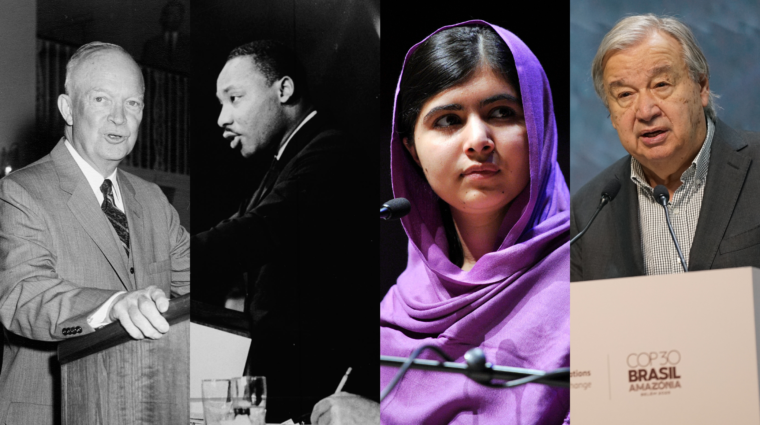
So to reflect, we’re taking a look back at some pivotal speeches on peace over the past century. Follow the links to find out more about or watch each of the speeches.
President Dwight D. Eisenhower – Chance for Peace (1953)
“Every gun that is made, every warship launched, every rocket fired signifies, in the final sense, a theft from those who hunger and are not fed, those who are cold and are not clothed.
This world in arms is not spending money alone. It is spending the sweat of its laborers, the genius of its scientists, the hopes of its children.”…
“This is one of those times in the affairs of nations when the gravest choices must be made, if there is to be a turning toward a just and lasting peace.
It is a moment that calls upon the governments of the world to speak their intentions with simplicity and with honesty.
President John F. Kennedy – Peace Speech (1963)
“Let us examine our attitude toward peace itself. Too many of us think it is impossible. Too many think it unreal. But that is a dangerous, defeatist belief. It leads to the conclusion that war is inevitable – that mankind is doomed – that we are gripped by forces we cannot control.
We need not accept that view. Our problems are manmade – therefore, they can be solved by man. And man can be as big as he wants. No problem of human destiny is beyond human beings. Man’s reason and spirit have often solved the seemingly unsolvable – and we believe they can do it again.
… Genuine peace must be the product of many nations, the sum of many acts. It must be dynamic, not static, changing to meet the challenge of each new generation. For peace is a process–a way of solving problems.”
Martin Luther King Jr – Nobel Peace Prize Acceptance Speech (1964)
“Nonviolence is the answer to the crucial political and moral question of our time – the need for man to overcome oppression and violence without resorting to violence and oppression. Civilisation and violence are antithetical concepts. Negroes of the United States, following the people of India, have demonstrated that nonviolence is not sterile passivity, but a powerful moral force which makes for social transformation.
If this is to be achieved, man must evolve for all human conflict a method which rejects revenge, aggression and retaliation. The foundation of such a method is love.”
The 14th Dalai Lama – Nobel Peace Prize Acceptance Speech (1989)
“Peace, in the sense of the absence of war, is of little value to someone who is dying of hunger or cold. It will not remove the pain of torture inflicted on a prisoner of conscience. It does not comfort those who have lost their loved ones in floods caused by senseless deforestation in a neighbouring country. Peace can only last where human rights are respected, where the people are fed, and where individuals and nations are free. True peace with oneself and with the world around us can only be achieved through the development of mental peace.”
Malala Yousafzai – Nobel Peace Prize Lecture (2014)
“Why is it that countries which we call “strong” are so powerful in creating wars but are so weak in bringing peace?
We are living in the modern age and we believe that nothing is impossible. We reached the moon 45 years ago and maybe we will soon land on Mars. Then, in this 21st century, we must be able to give every child quality education.”
Jane Goodall, UN Messenger of Peace (2017)
“Peace starts within. We have somehow to find peace within ourselves so that we can then reach out to others and spread this message of peace.
So how do you find peace within yourself when you live in a really difficult situation? When perhaps you’re a refugee? I think the only way I can think of doing this is each day to try to do your best to make the world around you just a little bit better. And if you can go to sleep each night thinking, “Well, I really did do my best”—maybe in a very difficult situation—then that will give you the kind of feeling that leads to peace. And then you’re better able to help others.”
António Guterres – Peace is the Missing Piece (2024)
“Peace is our raison d’être. Yet as I scan the landscape of today’s world, the one thing missing most dramatically is peace. And by that, I mean peace in all its dimensions. As conflicts rage and geopolitical divisions grow, peace in our world is threatened. As polarization deepens and human rights are trampled, peace within communities is undermined. As inequalities explode, peace with justice is shattered. As we continue our addiction to fossil fuels, we make a mockery of any notion of peace with nature.
At a pivotal time in the history of our world, we’ve been working with composer Philip Herbert and four poets, who have responded in their own ways to the prompt ‘Peace is the Missing Piece’. Our opening concert at this year’s festival asks audiences to take a step back and ask what peace really means.

